
Direct against indirect cold water: mains-fed or cistern-fed outlets, gravity pressure of about 0.1 bar per metre of head, and the trade-offs of each.
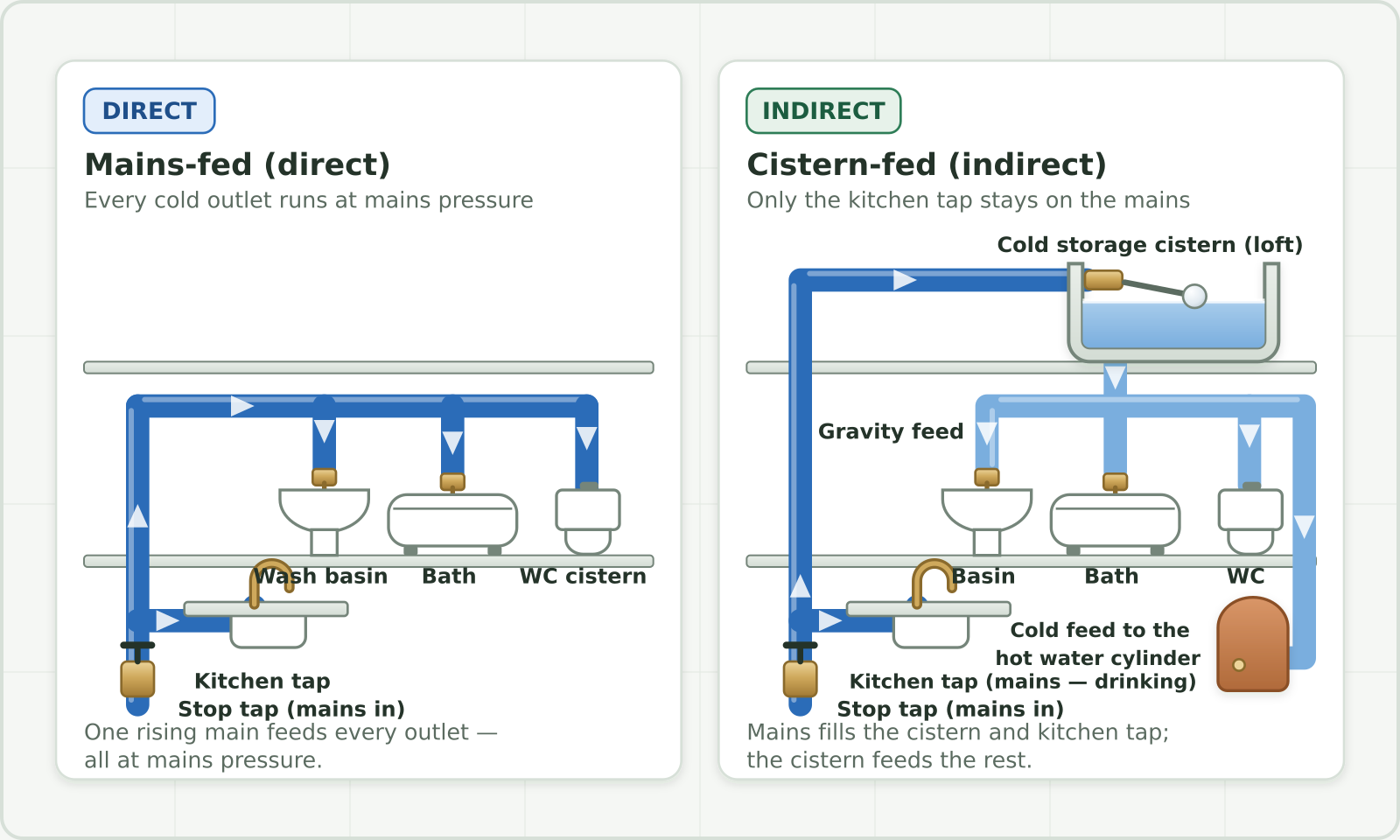
A direct system supplies cold outlets from the incoming main. An indirect system uses a storage cistern for some outlets. The diagram shows a common indirect arrangement: the kitchen drinking tap remains on the rising main while other outlets draw from storage. Trace the pipes on the actual installation; do not assume every house follows that layout.
Pressure and flow are different
A direct outlet depends on the available incoming pressure and flow, with losses through the supply pipe and fittings. Mains pressure is not necessarily high, and it can vary with demand.
For an unpumped cistern-fed outlet, static pressure depends on the vertical distance from the stored water surface to the outlet. Each metre gives approximately 0.1 bar. When water flows, pipe and fitting resistance reduces the pressure available at the outlet.
Worked example: a water surface 3 metres above an outlet gives about 0.3 bar static head. This is not a promise of 0.3 bar while a shower is running. Check the shower's required working pressure and flow, the pipe route and any simultaneous demand.
What storage can and cannot do
A correctly sized cistern can buffer a brief fall in incoming flow. It provides a finite reserve, not an unlimited supply or a guaranteed pressure boost. Usable volume, refill rate, height and outlet demand must work together. Excess storage can increase stagnation; do not choose a larger cistern simply because space is available.
Direct systems avoid that cold-water storage requirement but have no equivalent stored reserve at the outlets. Neither layout is universally better: select it for the available supply and the fittings it must serve.
Protect the water quality
Stored water must remain suitable for its use. Protect the cistern from contamination, provide appropriate inlet/backflow arrangements, cover and insulation, and maintain it. Mains connection alone also does not guarantee that downstream fittings are clean or correctly protected.
Do not label all cistern water unsafe by definition, or assume every bathroom tap is a drinking outlet. Identify the intended drinking-water supply and verify its quality and arrangement. G1 distinguishes drinking and washing supplies from suitable-quality flushing water.
Recall check: on the diagram, which outlet remains available directly from the rising main? The kitchen tap. Which outlets have a storage reserve? Those connected to the cistern, for as long as the usable stored volume lasts.
Something wrong, unclear or out of date? Report an issue with this note.